
The goal is not to find the lowest advertised overnight rate. It is to find the plan that produces the lowest total household bill for your actual usage.
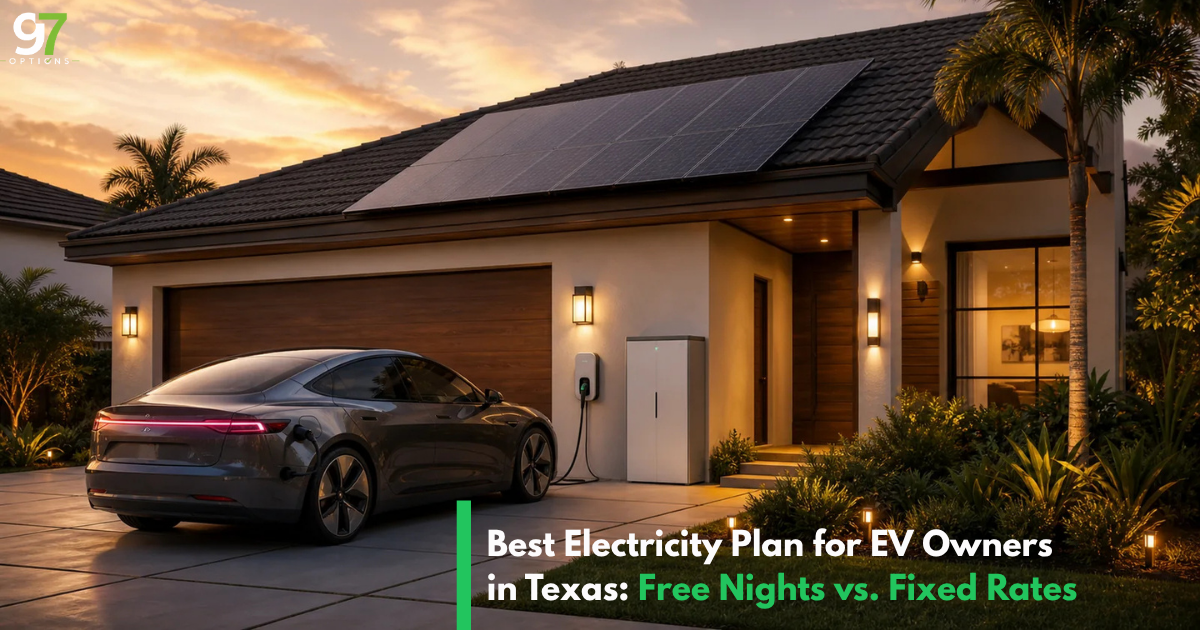
What Is the Best Electricity Plan for EV Owners in Texas?
There is no single plan that wins for every driver. Most EV electricity plans in Texas fall into three categories:
- Fixed-rate plans — the energy rate generally stays consistent throughout the contract rather than changing by time of day. However, your total bill still depends on usage, delivery charges, and plan-specific fees.
- Time-of-use (TOU) plans — electricity prices change by time period, with lower rates during selected off-peak hours and higher rates during peak periods.
- Free-night or EV-specific plans — selected nighttime hours may have a free or discounted energy charge, subject to the plan’s terms.
If most EV charging happens overnight and your daytime household load is moderate, a TOU or free-night plan may be attractive. If your home has heavy daytime demand, a competitive fixed-rate plan may work better.
Free Nights vs. Fixed-Rate Electricity for EV Charging
| Plan Type | Best For | Main Risk |
|---|---|---|
| Free Nights | Drivers who can shift most charging overnight | Higher daytime cost |
| Time-of-Use | Flexible charging schedules | Expensive peak-hour usage |
| Fixed Rate | Homes with substantial daytime use | No special overnight EV discount |
A “free electricity” headline only tells part of the story. A plan can make overnight charging inexpensive while charging more during the hours when your home uses air conditioning, appliances, lighting, and other equipment.
How Much Does It Cost to Charge an EV at Home in Texas?
A simple starting formula is:
When Off-Peak EV Charging Can Save You Money
Off-peak EV charging works best when your vehicle can reliably charge inside the plan’s discounted window. EVs are well-suited to this because charging is a large electrical load that can often be scheduled without affecting when you drive.
Schedule Your EV Charging Overnight
Many EVs and Level 2 home chargers allow scheduled charging through the vehicle or charger app. You can plug in when you arrive home but delay charging until the off-peak period begins.
Check the Electricity Facts Label Before Choosing an EV Plan

Before choosing an EV charging electricity plan, review the plan’s Electricity Facts Label (EFL). It provides key information about electricity prices and contract terms.
- Energy charges
- TDU delivery charges
- Base or monthly charges
- Minimum-usage requirements
- Bill-credit thresholds
- Prices at different monthly usage levels
- Contract length and early termination fees
- Exact free or discounted hours
An advertised average price can vary depending on usage and how fees or credits are structured. For EV owners, the daytime rate matters too because the vehicle is only one part of total household electricity use.
Use Your Actual Electricity Usage Before Switching Plans
Your own usage history is more useful than a generic household estimate. Look at daytime consumption, overnight consumption, seasonal air-conditioning demand, and when your EV normally charges.
Best Electricity Plan for Tesla and Other EV Owners
Tesla owners do not automatically need a Tesla-specific electricity plan. The same comparison applies to Rivian, Ford, Chevrolet, Hyundai, Kia, and other EVs.
How to Choose an EV Electricity Plan in Texas
Before signing a contract, compare:
- Overnight or off-peak rate
- Daytime or peak rate
- Exact free-charging hours
- Energy charge and TDU delivery charges
- Base or minimum-usage fees
- Bill-credit thresholds
- Contract length and early termination fee
- Your actual day-versus-night kWh usage
EV electricity plans vary by location and service territory. Drivers in Houston, Katy, Dallas-Fort Worth, and other deregulated Texas markets should compare plans available at their address.
Compare EV Electricity Plans for Your Actual Usage
The best EV charging plan in Texas is the one that fits your whole home—not just the hours when your car is plugged in. Compare the overnight rate, daytime rate, fees, delivery charges, and your real kWh pattern before switching.
Disclaimer: Electricity rates, fees, and plan availability can change; always review the latest Electricity Facts Label and contract terms before enrolling.