
Deregulated Energy States: The Complete 2026 Map & Guide
Updated July 2026
Every deregulated state, the utilities involved, real switching rates, and how energy choice actually works across the U.S.
- 20M+
- Homes Switched
- 3.8M+
- Businesses Switched
- 19
- Jurisdictions with Choice
- 87%
- Highest Switch Rate
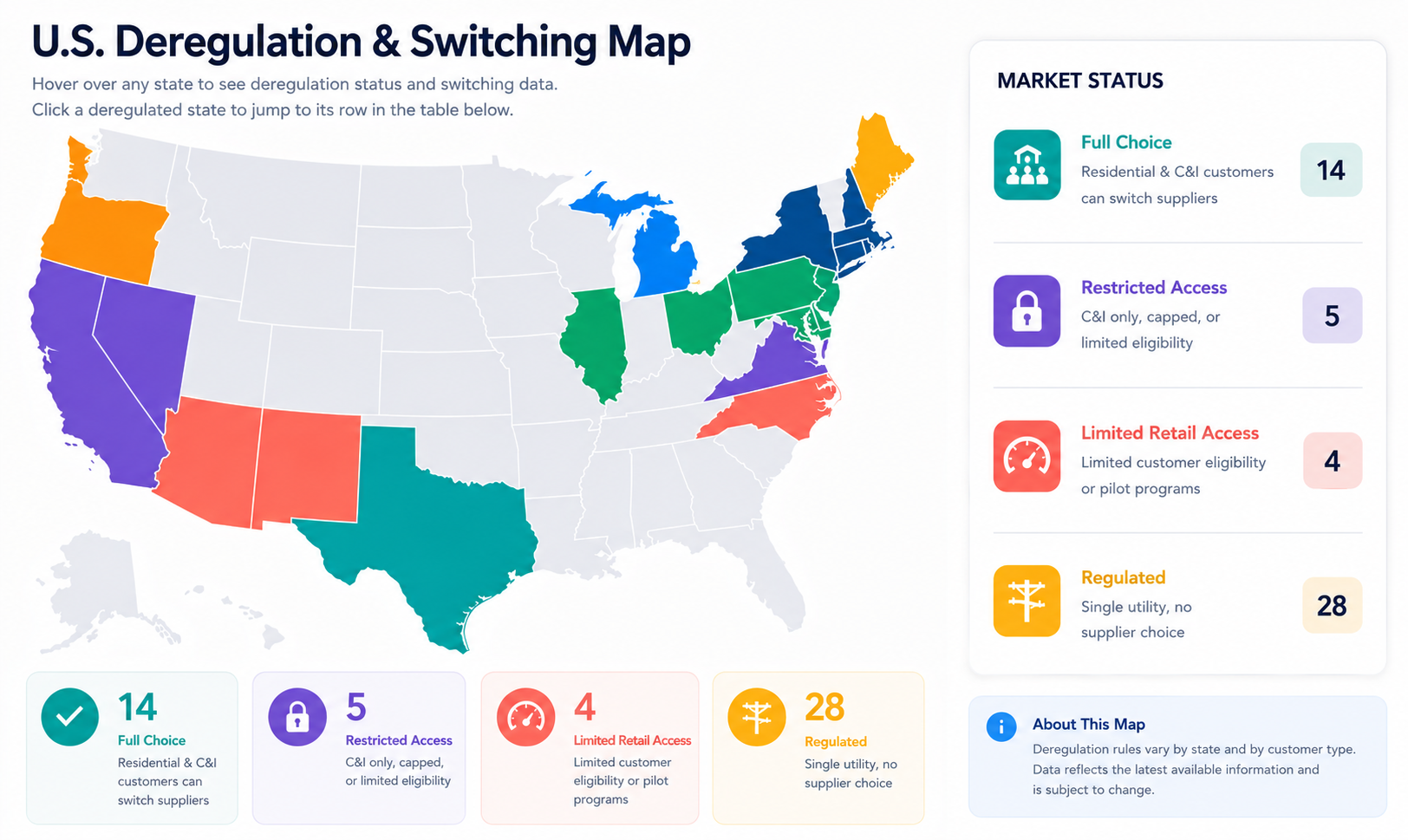
Residential & C&I customers can switch suppliers
C&I only, capped, or limited eligibility
Limited customer eligibility or pilot programs
Single utility, no supplier choice
If you live in the right state, you don't have to accept whatever rate your local utility hands you. Deregulated energy states give residents and businesses the legal right to shop around and choose their own electricity or natural gas supplier — often at a meaningfully better rate than the utility's default price.
Below is the complete picture: every deregulated state, the utilities involved, how deregulation actually plays out in practice, and how to check if you're eligible.
What "Deregulated Energy" Actually Means
In a regulated energy market, one utility company controls everything — generating the power, delivering it, and setting the price you pay. There's no competition, so there's no market pressure keeping that price down.
In a deregulated market, the utility still owns and maintains the physical wires and poles (and is who you call if the power goes out), but the supply portion of your bill — the actual electricity or gas you use — is opened up to competition. Independent retail suppliers compete for your business, meaning you can shop between them for a better rate, the same way you'd shop for a phone plan or insurance.
Your service and reliability never change based on which supplier you choose. The same utility keeps delivering power over the same lines no matter who bills you for it, and switching never causes an interruption in service.
U.S. Deregulation Market Status at a Glance
Of the 50 states plus D.C., the market breaks down into four clear categories:
- Full Choice — 14 states. Both residential and commercial/industrial (C&I) customers can freely switch suppliers.
- Restricted Access — 5 states. Choice exists but is capped, pilot-based, or C&I-only.
- Limited Retail Access — 4 states. Very narrow eligibility, often application-based or under specific enrollment windows.
- Regulated — 28 states. A single utility controls supply with no supplier choice available.
Full Choice States — Residential & Commercial
| State | Access | Year | Res. Rate | C&I Rate | Res. Switched | C&I Switched | Notes |
|---|---|---|---|---|---|---|---|
Texas | RES / C&I | 2002 | 87% | 87% | 10.5M | 1.65M | Mandatory choice inside ERCOT territory; over 100 competing retail providers make this the largest competitive market in the country. |
Ohio | RES / C&I | 1999 | 57% | 65% | 2.6M | 415K | Municipal aggregation programs auto-enroll residents in competitive rates, pushing participation well above most other states; 70+ PUCO-certified suppliers. |
Pennsylvania | RES / C&I | 1997 | 35% | 50% | 1.95M | 310K | 50+ licensed suppliers compete across PECO, PPL, and Duquesne Light territories; the state runs its own comparison tool, PA Power Switch. |
Illinois | RES / C&I | 1997 | 33% | 58% | 1.65M | 340K | Municipal aggregation is active in both ComEd and Ameren territories, under Illinois Commerce Commission oversight. |
New Hampshire | RES / C&I | 1996 | 28% | 50% | 155K | 38K | The first state in the country to pass electricity restructuring legislation (HB 1392), setting the template many others followed. |
Massachusetts | RES / C&I | 1998 | 22% | 40% | 600K | 185K | Municipal aggregation continues expanding across National Grid and Eversource territories. |
Rhode Island | RES / C&I | 1997 | 20% | 40% | 85K | 26K | Served through the Rhode Island Energy territory, formerly Narragansett Electric. |
Connecticut | RES / C&I | 1998 | ~14% | — | — | — | Eversource and United Illuminating both offer supplier choice; natural gas remains regulated for residential customers. |
New York, New Jersey, Maryland, Delaware, Maine, Washington D.C. | RES / C&I | Late 1990s–2000 | Varies | Varies | — | — | All offer full residential and commercial choice, though residential participation in NJ, MD, and DE has historically stayed in the low single digits despite full eligibility. |
Restricted, Capped, or C&I-Only Markets
| State | Access | Year | Res. Rate | C&I Rate | Res. Switched | C&I Switched | Notes |
|---|---|---|---|---|---|---|---|
Michigan | Capped 10% | 2000 | <1% | ~10% | <500 | 5,517 | The 10% competitive supply cap is consistently fully subscribed, with 5,100+ customers on the waitlist; 20+ licensed Alternative Electric Suppliers. |
Oregon | C&I Only | 2002 | N/A | ~20% | — | ~30K | No residential choice; served by Portland General Electric and Pacific Power, with structured annual enrollment windows for eligible commercial customers. |
California | C&I DA (capped) | 1998 | Suspended | Capped | — | Waitlisted | Residential direct access has been suspended since 2001; commercial/industrial access is capped around 28,800 GWh, while 25+ Community Choice Aggregators operate separately under their own rules. |
Virginia | Limited | 1999 | <1% | <3% | ~5K | ~12K | HB 921, effective July 1, 2026, removed the previous 1% cap — any nonresidential customer over 5 MW is now eligible, and Dominion offers a carbon-free tariff option. |
Nevada | C&I Only | 2001 | N/A | Limited | — | N/A | Application-based eligibility for large commercial/industrial customers only, within NV Energy territory; exit fees apply. |
States With Deregulated Natural Gas
Many of the same states that deregulated electricity also allow consumers to choose their natural gas supplier, though the two lists don't perfectly overlap. In a deregulated gas market, you pick the company that procures your gas — the local utility still delivers it through the same pipeline network, identical to how electricity deregulation works.
At least 16 states plus D.C. currently offer some form of natural gas choice:
| State | Residential Gas Choice | Key Gas Utilities |
|---|---|---|
| Georgia | Full choice (electricity remains regulated) | Georgia Natural Gas, Atlanta Gas Light |
| Ohio | Full choice | Columbia Gas of Ohio, Dominion Energy Ohio |
| New York | Full choice | Con Edison, National Grid, NYSEG |
| Pennsylvania | Full choice | PECO, UGI, Peoples Gas |
| New Jersey | Full choice | PSE&G, New Jersey Natural Gas |
| Maryland | Full choice | Baltimore Gas and Electric, Washington Gas |
| Illinois | Full choice | Nicor Gas, Peoples Gas |
| Massachusetts | Full choice | National Grid, Eversource |
| Rhode Island | Full choice | Rhode Island Energy |
| Delaware | Full choice | Delmarva Power |
| New Hampshire | Limited | Liberty Utilities, Unitil |
| Maine | Commercial/industrial only | Summit Natural Gas |
| Virginia | Limited | Columbia Gas, Washington Gas |
| Connecticut | Not available residentially | — |
Georgia is the notable outlier on this list — it's the only state with full residential natural gas choice while electricity remains completely regulated, the reverse of most deregulated states.
Recent Market Developments
Deregulated markets continue to shift. As of December 2025, New York's municipal electric Community Choice Aggregation (CCA) programs ended statewide and are currently under review by the state's Public Service Commission — a reminder that even established markets change, and it's worth periodically re-checking your eligibility even in a state you've shopped in before.
One consistent pattern across every deregulated state: commercial and industrial switching rates exceed residential rates virtually everywhere, largely because businesses have dedicated staff or brokers actively managing energy costs, while most residential customers simply never check.
This page compiles data from EIA Form 861, state public utility commission filings, ISO/RTO market reports, and utility-published shopping statistics. Figures are updated periodically and reflect general market conditions rather than real-time numbers.
Figures reflect commonly reported industry data as of 2026, compiled from multiple public sources including state utility commissions and industry trackers. Individual eligibility always depends on your specific utility territory.
How Deregulation Actually Plays Out: Switching Activity by State
A state being deregulated on paper doesn't always mean residents actually take advantage of it. Real switching rates — the share of eligible customers who've actually chosen an alternate supplier — tell a more useful story than the on-paper status alone:
- Texas has the highest residential switching rate of any deregulated state, commonly cited around 87% — reflecting its fully competitive, mandatory-choice ERCOT market with well over 100 active retail providers.
- Ohio follows at around 57%, driven heavily by municipal aggregation programs that automatically enroll residents in a competitively-bid rate unless they specifically opt out.
- Pennsylvania sits around 35% and Illinois around 33% — both meaningful, active markets, but with a larger share of residents remaining on utility default service compared to Texas or Ohio.
The consistent pattern across nearly every deregulated market: switching rates track closely with consumer awareness and how simple the shopping process is. States and cities where shopping is well-publicized or automatic, like Ohio's aggregation model, see far higher participation than markets where the average resident doesn't realize they even have a choice.
A Brief History of Energy Deregulation in the U.S.
- 1992 — The Energy Policy Act opened U.S. wholesale electricity markets to competition for the first time.
- 1996 — FERC Orders 888 and 889 required utilities to open their transmission systems to competing suppliers, and Rhode Island became one of the first states to restructure its retail market.
- 1997–2000 — A wave of states passed restructuring legislation, including Pennsylvania, Massachusetts, Maryland, and Maine.
- 1999–2002 — Texas passed its restructuring law and fully implemented retail choice by 2002, eventually becoming the most competitive energy market in the country.
- 2000–2001 — The California energy crisis caused rolling blackouts, utility bankruptcies, and severe price spikes. California ultimately suspended residential choice, and the crisis temporarily cooled national momentum for deregulation elsewhere.
- 2010s–present — Deregulated markets matured significantly, with growing emphasis on renewable energy plans, community aggregation programs, smart-grid technology, and stronger consumer protections. Some states, like Virginia, have continued expanding commercial eligibility as recently as 2026.
How to Check If You Can Choose Your Provider
- Confirm your state offers choice for the specific utility type you're checking — electricity, gas, or both — using the tables above.
- Confirm your specific utility participates. Not every territory within a deregulated state is open to choice; some municipal utilities and cooperatives opt out entirely.
- Find your current rate. Check your most recent bill for what you're paying per kWh (electricity) or per therm/Mcf (gas) specifically for the supply portion — that's the number worth comparing.
- Compare available plans, paying close attention to rate, contract length, early termination fees, and whether it's fixed or variable.
- Enroll. Switching typically takes just a few minutes online, with no interruption in service at any point.
Compare Plans in Your State
97 Options currently serves customers across Texas, Illinois, Pennsylvania, New Jersey, Ohio, and Connecticut — six of the most active deregulated energy markets in the country. Enter your ZIP or upload a bill, and Maya AI will check whether you're already on a competitive rate.
Frequently Asked Questions
How many states have deregulated electricity?
Roughly 18 states plus Washington, D.C. currently offer some form of residential electricity choice, though access ranges from full statewide competition (like Texas or Pennsylvania) to limited commercial-only programs (like Oregon or Nevada).
How many states have deregulated natural gas?
At least 16 states plus D.C. offer some form of natural gas choice, and the list of gas-deregulated states doesn't perfectly overlap with electricity — Georgia, for example, has full residential gas choice but remains fully regulated for electricity.
Does switching providers interrupt my power or gas service?
No. The utility continues to deliver electricity or gas over the same physical infrastructure regardless of which supplier bills you. Switching is strictly a billing and pricing change.
Can a state be deregulated for electricity but not natural gas, or vice versa?
Yes, very commonly. Connecticut, for example, offers electricity choice but does not currently offer a deregulated residential natural gas market. Always check each utility type separately.
Why did some states reverse or limit deregulation?
California suspended residential electric choice after the 2000–2001 energy crisis caused rolling blackouts and utility bankruptcies. A few other states, including Montana and Nevada, also pulled back or limited their programs after early implementations didn't deliver the expected consumer benefits. Most states that fully implemented deregulation, however, have maintained stable, competitive markets since.
What if my state isn't deregulated at all?
You're required to purchase electricity and gas from your local utility at their regulated, government-approved rate. There's currently no legal way to shop for an alternate supplier in fully regulated states.
Is a "capped" market like Michigan the same as full deregulation?
No. In capped markets, only a limited percentage of total utility load is allowed to switch to competitive suppliers — once that cap is reached, new customers are placed on a waitlist. Michigan's competitive supply cap, for example, is typically fully subscribed at any given time.