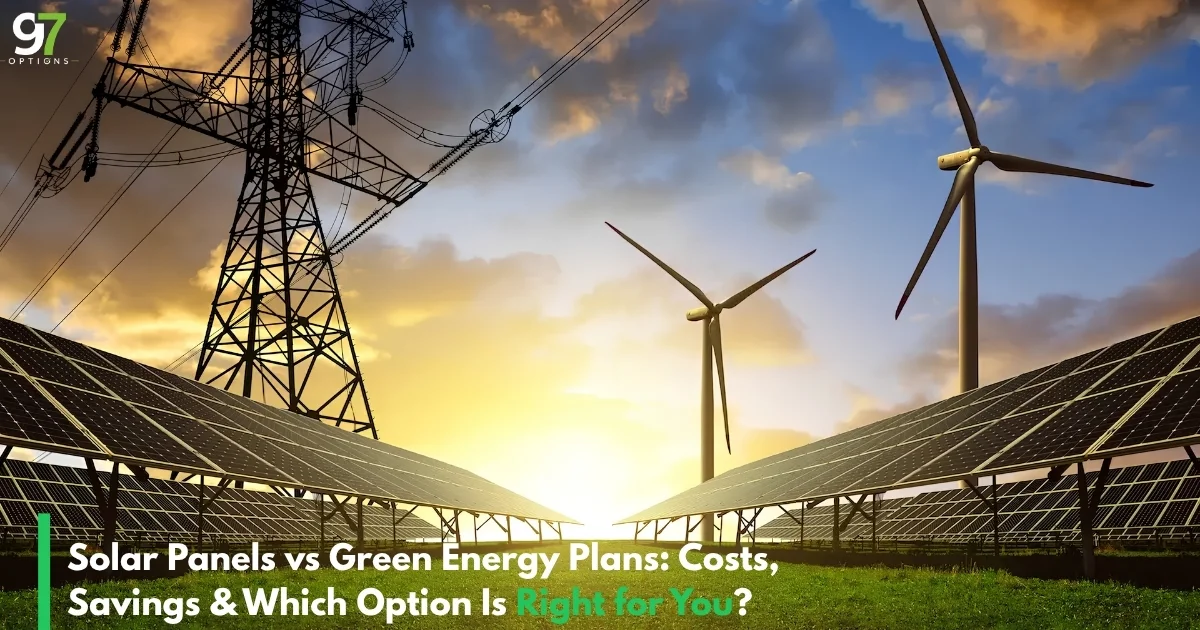
Solar Panels vs Green Energy Plans: Costs, Savings & Which Option Is Right for You?
If you want to support cleaner electricity at home, two common options are installing rooftop solar panels or choosing a green energy plan. Both can be part of a renewable energy strategy, but they work very differently.
July 27, 20266 min readUpdated September 16, 2026
Share:
Table of Contents▾
Solar panels generate electricity directly at your property and require equipment, installation, and a long-term commitment. A green energy plan requires no rooftop equipment and typically relies on renewable energy sources and Renewable Energy Certificates to support its renewable electricity claims.
Cost, flexibility, homeownership, electricity usage, and long-term goals can all influence which option makes more sense. For consumers comparing electricity choices, resources such as 97Options can also make plan details easier to understand before selecting an electricity supplier.
Solar Panels vs Green Energy Plans at a Glance
Before looking at each option in detail, here is a quick comparison of solar panels vs green energy plans.
Factor
Solar Panels
Green Energy Plans
Upfront cost
Usually higher
Usually little or no installation cost
Equipment
Required
Not required
Onsite generation
Yes
No
Homeownership
Usually best for homeowners
Suitable for homeowners and many renters
Installation
Required
None
Maintenance
Generally low, but owner responsibility
No generation equipment to maintain
Grid connection
Usually remains connected
Required
Flexibility
Lower
Higher
Long-term savings
Potentially significant, but varies
Depends mainly on electricity rate and plan terms
The main difference between the green energy plan and the solar panels decision is ownership. Solar means investing in your own electricity-generating equipment, while a green electricity plan lets you support renewable generation without installing a system at your property.
How Do Rooftop Solar Panels Work?
Rooftop solar panels convert sunlight into electricity that can be used directly by your home. Production depends on factors such as system size, roof orientation, shading, local weather, and available sunlight.
Most residential solar homes remain connected to the electricity grid. When panels are not producing enough electricity to meet current demand, such as at night, the home can generally draw electricity from the grid. Homes with battery storage may be able to store some excess production for later use.
What happens to electricity generated beyond the home's immediate needs depends on local utility rules, the electricity market, and available export or buyback programs.
Installing rooftop solar normally involves equipment, labor, permitting, and other upfront costs. It may therefore be better suited to homeowners who expect to remain in the property long enough for potential solar panel savings to offset some or all of the initial investment.
Before making that decision, homeowners should evaluate roof suitability, projected production, installation terms, and other factors involved in residential solar energy.
What Is a Green Energy Plan?
A green energy plan provides another way to support renewable electricity without installing solar panels or other generation equipment at your home.
Your electricity still arrives through the same shared power grid. What changes is the electricity product you purchase and how its renewable attributes are sourced, tracked, and substantiated.
Many renewable electricity plans use Renewable Energy Certificates (RECs) to account for the renewable electricity generated by the plan. The exact renewable percentage, generation sources, contract terms, and pricing can vary between plans.
This makes green electricity particularly accessible for people who cannot install solar panels. In areas with competitive electricity markets, eligible renters may also be able to select a renewable plan without making changes to the property.
Solar Panels vs Green Energy Plans: Key Differences
Upfront Cost
Cost is one of the biggest differences between solar panels and renewable energy plans.
Rooftop solar requires a physical system, which means paying for panels, installation, related equipment, and potentially financing costs. Actual pricing varies significantly by home and system.
A green electricity plan does not require rooftop installation. Instead, consumers mainly need to compare electricity rates, renewable content, fees, and contract terms.
For someone who wants renewable electricity without solar panels, a green energy plan therefore has a much lower barrier to entry.
Long-Term Savings
Solar panels can potentially provide substantial long-term electricity savings, but those savings are not guaranteed. Results depend on electricity consumption, system production, installation costs, financing, local electricity prices, export compensation, and the length of time the homeowner keeps the system.
Under a green energy plan, financial performance depends much more heavily on electricity rates and contract structures. A renewable plan could cost less, about the same, or more than another available electricity plan depending on market conditions.
Consumers should therefore compare the complete plan rather than assuming that “green” automatically means cheaper or more expensive.
Installation and Maintenance
Solar panels require physical installation, permitting, electrical work, and a suitable roof. Modern systems generally require limited routine maintenance, but equipment condition and system performance remain the homeowner's responsibility.
A green power plan requires no generation equipment. Enrolling or switching plans is typically the main action required, making it much simpler for consumers who do not want to manage a physical energy system.
Flexibility
Solar panels are attached to a property and typically represent a long-term investment. That makes them more attractive to homeowners planning to remain in their homes for years.
Green electricity plans are generally more flexible because no equipment is tied to the property. This is one reason green energy for renters or people expecting to relocate can be more practical than rooftop solar ownership.
Are Green Energy Plans Really Renewable?
This is one of the most important parts of understanding a 100% renewable electricity plan.
Electricity from different generating sources enters a shared grid. Once electricity is on that grid, the power arriving at an individual home cannot normally be separated into uniquely identifiable “solar,” “wind,” or conventional electrons.
Instead, Renewable Energy Certificates are used to track the renewable attributes associated with qualifying electricity generation.
One REC represents the renewable attributes associated with one megawatt-hour of renewable electricity generated and delivered to the grid. RECs play an important role in accounting for renewable generation and substantiating claims of renewable electricity.
Consumers comparing plans should therefore review renewable-content disclosures and understand what supports a plan's environmental claims.
Which Option Is Better for Homeowners and Renters?
Homeowners
Solar panels for homeowners may be worth evaluating when:
The roof has suitable sunlight and limited shading.
The homeowner expects to stay in the property long term.
The upfront investment or financing terms fit the budget.
Onsite electricity generation is an important goal.
Projected savings make sense based on actual household usage.
Solar should be evaluated as a long-term home energy investment rather than simply as another electricity plan.
Renters
A green energy plan for renters is often more practical because no roof ownership or installation is required.
Where retail electricity choice is available, eligible renters may be able to select renewable electricity just as they would another electricity plan. This provides a relatively simple way to support renewable generation without owning the building.
Plan availability still depends on location and electricity market rules.
Can You Use Solar Panels and a Green Energy Plan Together?
Yes, depending on the electricity market and the plans available in your service area.
Having rooftop solar does not necessarily eliminate the need for an electricity supplier. Solar production varies throughout the day, and many grid-connected homes continue to purchase electricity when their systems are not producing enough to meet demand.
Homeowners with existing panels should also investigate solar buyback plans, export compensation, or other available arrangements. These may be more relevant than choosing a standard green electricity plan.
In other words, a solar electricity plan designed for a home with existing panels can serve a different purpose from a renewable plan designed for customers without onsite generation.
How to Compare Green Electricity Plans
If a green energy plan looks like the better option, compare more than just the renewable percentage.
Check:
Electricity rate
Renewable content
Contract length
Fixed or variable pricing
Early termination fees
Minimum usage requirements
Renewal conditions
Other recurring charges
Electricity Facts Label, where applicable
The cheapest advertised rate is not always the cheapest rate for your actual usage. Contract structures and usage-based charges can significantly change the final electricity bill.
Solar Panels or a Green Energy Plan: Which Should You Choose?
There is no universal winner in the solar panels vs green energy plans comparison.
Rooftop solar may be worth evaluating if you own your home, have a suitable roof, expect to remain there long-term, and want to generate electricity on-site. It offers greater control over home generation and may provide meaningful long-term savings when the economics are favorable.
A green energy plan may be more suitable if you rent, expect to move, want to avoid installation costs, or prefer a simpler way to support renewable electricity through your existing grid connection.
The best choice ultimately depends on your property, budget, electricity consumption, available plans, and long-term goals—not simply whether one option is labeled “solar” or “green.”
Disclaimer: Electricity rates, plan availability, solar savings, and incentives vary by location, provider, usage, and market conditions.
Frequently Asked Questions
Are green energy plans cheaper than solar panels?
Green energy plans generally have much lower upfront costs because they do not require installation or equipment. Over the long term, however, the better financial option depends on solar system costs, electricity rates, usage, financing, and other factors.
Do I need solar panels to use renewable electricity?
No. In markets where renewable electricity products are available, consumers can choose a green energy plan without installing rooftop solar panels.
Can renters choose green energy plans?
In many competitive electricity markets, eligible renters can choose green electricity plans because no permanent equipment or property modification is required. Availability depends on the service area and local market.
Are solar panels better than renewable electricity plans?
Neither option is automatically better. Solar offers onsite generation and potential long-term savings, while renewable electricity plans offer greater simplicity, flexibility, and lower upfront commitment.
What are Renewable Energy Certificates?
Renewable Energy Certificates represent the renewable attributes associated with qualifying electricity generation. In the United States, one REC is issued for one megawatt-hour of renewable electricity generated and delivered to the grid.